
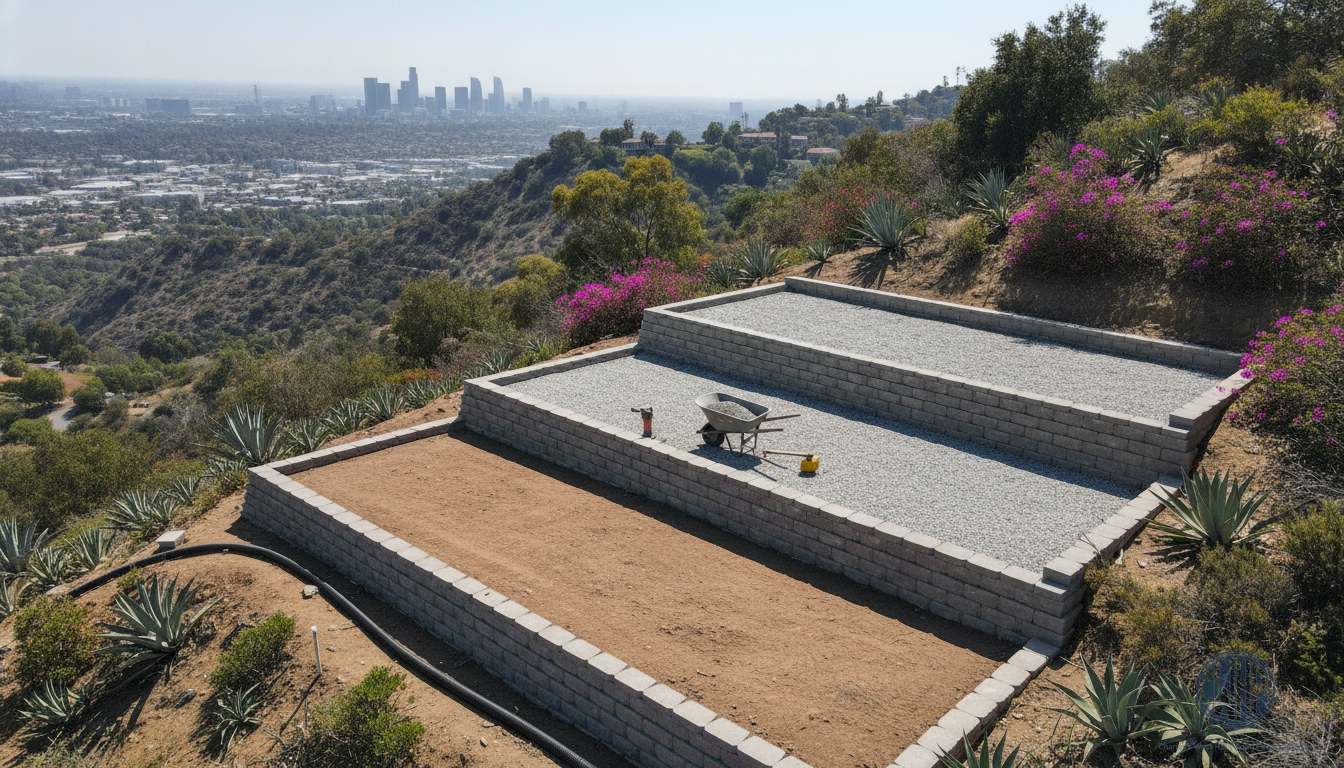
If you own a home on a sloped lot in Hollywood Hills or the hilly streets of West Hollywood, you already know the challenge: dramatic views, unique architecture, and a yard that's too steep to actually use. Runoff erosion, soil movement, and the risk of slope failure are real concerns — especially during the kind of heavy seasonal rainfall events that Southern California increasingly experiences. The solution that combines structural performance, practical outdoor living, and genuine curb appeal is a professionally built retaining wall and paver terrace system.
At Charles's West Hollywood Pavers Installers, we specialize in retaining wall construction and paver terrace installations on the sloped and hillside properties common throughout the 90046 area. Here's everything you need to understand before planning your project.
Why Sloped Lots in West Hollywood Need Special Attention
The hills above Sunset Strip and throughout the Hollywood Hills foothills are made up of a complex mix of sedimentary soils, expansive clay layers, and decomposed granite, depending on the exact location. These soils behave very differently when wet versus dry. Clay expands significantly when it absorbs moisture and contracts as it dries — a cycle that causes gradual soil creep, which is the slow downhill movement of the upper soil layer over time.
Without a properly engineered retaining structure, this soil movement can undermine foundations, crack driveways, and send landscaping downhill. It's not a matter of aesthetics — on some lots, it's a structural and safety issue. A well-built retaining wall interrupts that movement, stabilizes the slope, and creates flat areas that are genuinely usable and buildable.
Retaining Wall Materials: Which Is Right for Your Property?
Not all retaining walls are built the same way, and the right material depends on your wall's height, the soil conditions on your lot, the aesthetic of your home, and your budget. Here are the most common options we use on West Hollywood and Hollywood Hills projects:
- Segmental Concrete Retaining Blocks: The most widely used material for residential retaining walls. These engineered blocks interlock or set-back slightly with each course, creating a battered (angled) wall face that naturally resists the lateral force of retained soil. Available in a range of textures and colors to complement both contemporary and traditional home styles. Extremely durable and proven in seismic zones like Southern California.
- Natural Stone: Dry-stacked or mortared natural stone walls bring an organic, timeless look that blends seamlessly into California hillside landscapes. Granite, limestone, and river stone are all popular choices. Natural stone walls do require more skilled labor than block walls, and they're typically more appropriate for lower heights — garden borders and single-terrace walls under 3 feet.
- Brick: Mortared brick retaining walls are a beautiful option for properties in historically influenced neighborhoods like Hancock Park or Larchmont where the surrounding architecture calls for warm, traditional materials. Brick is best suited for decorative or low garden walls rather than high load-bearing applications.
The Drainage System Is the Most Important Part
We say this to every client who asks us to build a retaining wall: the drainage system behind the wall is more important than the wall itself. Here's why. When rain falls on a hillside, water percolates down through the soil and accumulates in the retained earth behind a wall. Without a way to escape, this water creates hydrostatic pressure — essentially, it pushes against the back of the wall. Given enough pressure over enough time, even a well-built wall will bow, crack, or tip forward.
Every retaining wall we build at Charles's West Hollywood Pavers Installers includes:
- A compacted gravel drainage layer (typically crushed stone, 3/4-inch minus) placed directly behind the wall
- Perforated pipe (drain tile) running along the base of the wall, sloped to daylight at an appropriate outlet point
- Filter fabric to separate the drainage gravel from the native soil and prevent fine particles from clogging the system
- Proper surface drainage design to direct runoff away from the top of the wall
These details add cost to the project — but they're what separates a wall that performs for 30 years from one that fails in 5.
Permits and Engineering: What West Hollywood Homeowners Need to Know
In most California jurisdictions, retaining walls under 4 feet in height (measured from the bottom of the footing to the top of the wall) can be built without a licensed structural engineer's stamp, though a building permit may still be required. Walls taller than 4 feet almost universally require engineering review and permit approval before construction can begin.
For walls on the City of West Hollywood's jurisdiction, we strongly recommend contacting the Building & Safety Division before beginning any retaining wall project to confirm current permit requirements for your specific property and slope conditions. Properties in hillside overlay zones may have additional requirements. Our team can help you understand what documentation is typically requested during the planning phase, though permit submissions are ultimately the homeowner's responsibility.
Turning a Retained Slope into an Outdoor Living Space
Once the structural work is done and you have flat, stable terraced areas, the real fun begins — designing usable outdoor spaces that take advantage of West Hollywood's near-perfect year-round climate. Here's how our clients typically develop their newly terraced lots:
- Upper Terrace — Patio and Dining Area: The level behind the primary retaining wall becomes the natural location for an outdoor dining table, lounge seating, or a built-in fire pit. Our patio paver installation service handles this beautifully, using the same block or stone material as the wall for a cohesive look, or introducing a contrasting travertine or concrete paver for a layered, designed aesthetic.
- Mid Terrace — Garden Beds and Planting Areas: Lower-height walls creating garden bed borders are an excellent way to introduce lush planting on a hillside lot. Drought-tolerant California native plants — manzanita, agave, bougainvillea, and lavender — thrive in raised bed conditions and add dramatic visual interest to the terraced landscape.
- Connecting Elements — Steps and Walkways: Multi-tiered terraces need connecting pathways. Paver staircases using matching or complementary materials tie the levels together beautifully and safely. Our walkway and pathway installation team handles everything from simple stair runs between two terraces to elaborate path systems that wind through hillside garden areas.
Real Project Example: A Hollywood Hills Terrace Transformation
One of our recent projects in the 90046 zip code involved a 1950s hillside home with a rear yard that dropped sharply within just 20 feet of the back door — making the space completely unusable for outdoor living. We designed a two-wall terrace system: a 4-foot segmental block primary wall creating a 12-by-20-foot level patio area directly behind the home, and a secondary 3-foot wall creating a planting terrace below. The patio was finished with large-format charcoal concrete pavers, and a staircase of three steps connected the patio to the lower garden terrace. A complete drainage system — gravel backfill, perforated pipe, and surface drainage grading — was integrated into both walls. The homeowners went from a backyard they never used to a true outdoor living room with a fire pit table and views over the canyon below.
If you're a homeowner in Hollywood Hills, West Hollywood, Studio City, or any other hillside neighborhood in the area, Charles's West Hollywood Pavers Installers is ready to evaluate your slope and design a retaining wall and terrace system that works with your land — not against it. Call us at (213) 456-8536 or stop by our office at 8159 Santa Monica Blvd, Suite 203, West Hollywood, CA 90046 to get started with a free site assessment.
Need Service?
Call +12134568536 or fill out our online form for a free, no-obligation quote.
Request Free Quote